
Introduction
Most people believe they need thousands of dollars to start building wealth. A survey by the UK’s Investment Association found that the average Briton thinks they need around £41,300 (roughly $52,000) before they can invest — and younger adults aged 18–30 overestimate even more, at around £58,000. The truth? You can begin investing for beginners with little money — as little as $1 on many modern platforms. The barrier to entry has never been lower, yet millions of people across the United States, the United Kingdom, and Europe still keep their money sitting idle in savings accounts earning next to nothing.
This guide breaks down, step by step, how to start investing with just $100. You will learn the types of investments available, how to open your first brokerage account, why index funds often outperform stock picking, and what real growth looks like when you commit small amounts consistently over time. Whether you are in New York, London, or Berlin, the principles here apply to you. No jargon. No hype. Just a clear, practical roadmap to get your money working for you.
Table of Contents
- Why Start Investing Now
- Types of Investments Explained Simply
- How to Open a Brokerage Account
- Index Funds vs Individual Stocks
- Start With $100: A Real Example
- Common Beginner Mistakes to Avoid When Investing With Little Money
- FAQs
- Conclusion
Why Start Investing Now
Time is the single most powerful asset a beginner investor has, and it costs nothing. The reason is compound interest — your returns generate their own returns, and the effect snowballs over decades. Albert Einstein reportedly called compound interest the “eighth wonder of the world,” and the math backs up the sentiment.
Consider this: the S&P 500, which tracks 500 of the largest U.S. companies, has delivered an average annual return of roughly 10% over the past 30 years, according to data from Trade that Swing analyzed through February 2026. Even after adjusting for inflation, that figure hovers around 7%. The longer your money stays invested, the more dramatic the compounding effect becomes.
Waiting is expensive. If you invest $100 per month starting at age 25, with an average 10% annual return, you would have approximately $226,000 by age 55. Start the same habit at age 35, and you would have only around $79,000 by the same age. That ten-year delay costs you roughly $147,000 — money you never had to earn, but lost by waiting.
Inflation is another reason to act now. Cash sitting in a standard savings account typically earns between 0.5% and 2% interest. With inflation running at 2–4% annually in most developed economies, your money is actually losing purchasing power every year it sits idle. Investing is one of the few reliable ways to outpace inflation over the long run.
The bottom line: the best time to start investing was years ago. The second-best time is today.
Types of Investments Explained Simply
Before you invest a single dollar, it helps to understand what you are actually buying. Here are the most common investment types a beginner will encounter.
Stocks represent ownership in a single company. When you buy a share of Apple or Unilever, you own a tiny piece of that business. If the company grows, your share becomes more valuable. If it struggles, you can lose money. Stocks offer high growth potential but come with higher risk, especially if you concentrate your money in just one or two companies.
Bonds are essentially loans you make to a government or corporation. In return, they pay you regular interest and return your principal at a set date. Bonds are generally less volatile than stocks, making them popular for more conservative investors or those closer to retirement. U.S. Treasury bonds, UK gilts, and EU government bonds are among the safest options, though they offer lower returns.
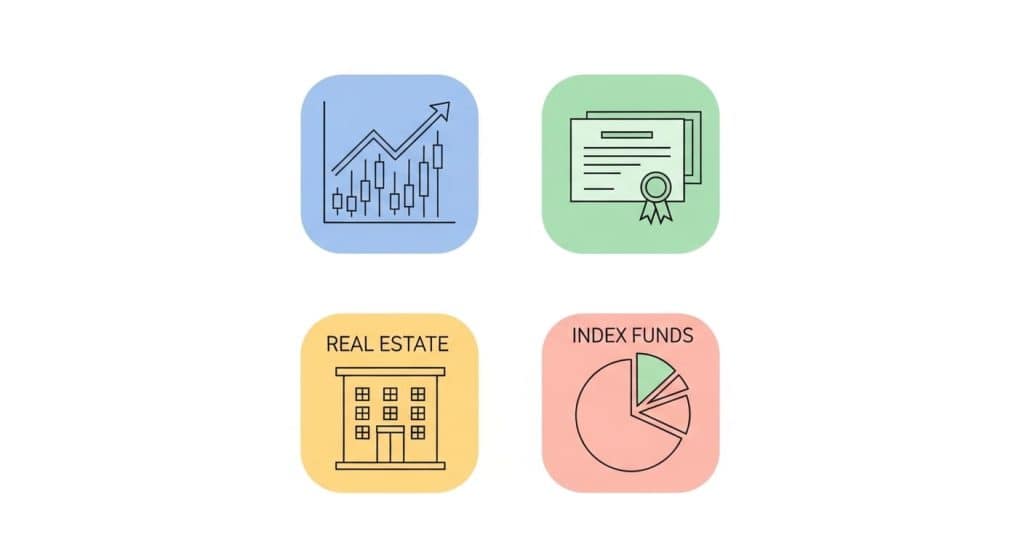
Index Funds and ETFs (Exchange-Traded Funds) bundle dozens or hundreds of stocks into a single investment. For example, an S&P 500 index fund holds shares in all 500 companies in the index. This gives you instant diversification — spreading your risk across many companies instead of betting on just one. Index funds are widely considered one of the best options for beginners investing with little money because of their low fees and broad exposure.
Real Estate Investment Trusts (REITs) allow you to invest in property without actually buying a building. REITs are companies that own income-producing real estate and distribute most of their profits as dividends to shareholders. You can buy shares in a REIT through most brokerage platforms.
High-Yield Savings Accounts and CDs are not investments in the traditional sense, but they play an important role in a financial plan. They offer safety and liquidity for your emergency fund or short-term goals. They should complement, not replace, a long-term investment strategy.
For a deeper understanding of how to manage your money before investing, read more .
How to Open a Brokerage Account
Opening a brokerage account is easier than setting up most social media profiles. Here is a straightforward process that works regardless of where you live.
Step 1: Choose a Platform. Pick a brokerage that offers commission-free trading, low or no account minimums, and a user-friendly interface. In the U.S., popular beginner-friendly options include Fidelity, Charles Schwab, and Robinhood. In the UK, platforms like Trading 212, Vanguard UK, and Hargreaves Lansdown are well-established. In the EU, Trade Republic, DEGIRO, and Interactive Brokers are widely used. According to Forbes Advisor’s 2026 rankings, Robinhood, Acorns, and Fidelity consistently rank among the best apps for new investors.
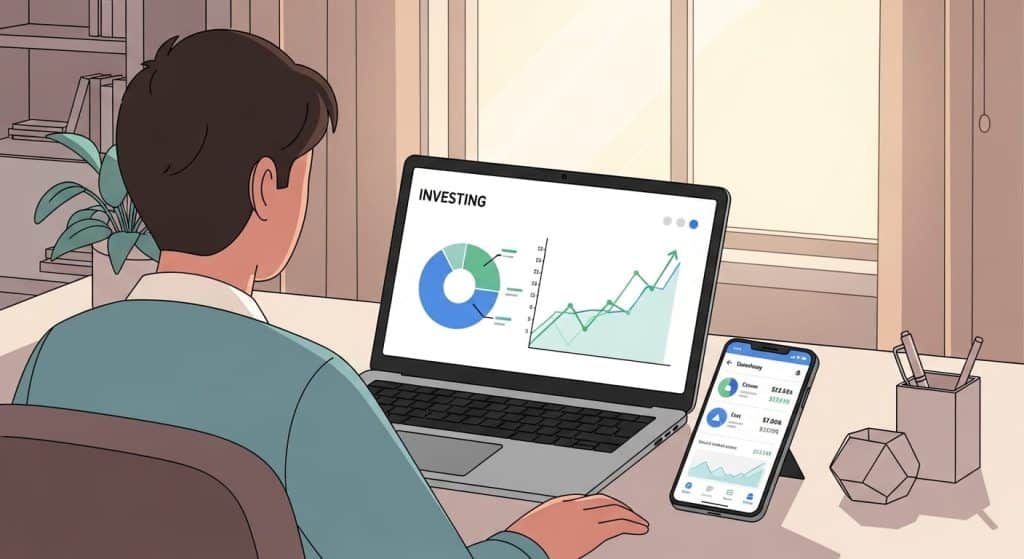
Step 2: Gather Your Information. You will need a government-issued ID, your Social Security number (or national equivalent), your bank account details, and your residential address. The process is digital on most platforms and takes about 10–15 minutes.
Step 3: Fund Your Account. Transfer money from your bank account. Many brokerages allow you to start with as little as $1. Some, like Acorns, even invest your spare change by rounding up everyday purchases to the nearest dollar.
Step 4: Choose Your First Investment. For most beginners, a low-cost index fund is the smartest starting point. Look for funds with expense ratios below 0.20%. The Vanguard S&P 500 ETF (VOO), for example, has an expense ratio of just 0.03%, meaning you pay only $0.30 per year for every $1,000 invested.
Step 5: Set Up Automatic Contributions. This is perhaps the most important step. Automating your investments removes emotion and procrastination from the equation. Even $25 per week adds up to $1,300 per year — before any growth.
If you are in the UK, consider opening a Stocks and Shares ISA, which shelters your investment gains from tax. In the EU, look into equivalent tax-advantaged accounts in your country. In the U.S., a Roth IRA offers tax-free growth on qualified withdrawals.
Index Funds vs Individual Stocks
This is one of the most important decisions a beginner investor will make, and the data strongly favors one side.
The S&P Global SPIVA Scorecard for year-end 2025 found that 79% of all actively managed large-cap U.S. equity funds under performed the S&P 500 — up from 65% in 2024 and the fourth-worst year for active managers in the scorecard’s 25-year history. If professional fund managers with teams of analysts, proprietary data, and decades of experience cannot consistently beat a simple index fund, it is unrealistic for a beginner to expect better results picking individual stocks.
Index funds offer several advantages that make them ideal for beginners investing for the first time with little money. They provide instant diversification across hundreds of companies, which dramatically reduces the impact of any single stock collapsing. They charge minimal fees, often under 0.10% per year. And they require zero research or active management on your part — you simply buy and hold.
Individual stocks, on the other hand, can deliver enormous returns. A $100 investment in Amazon at its 1997 IPO would be worth over $200,000 today. But for every Amazon, there are hundreds of companies that failed or delivered mediocre returns. Research published in the Journal of Financial Economics has shown that most individual stocks actually under perform Treasury bills over their lifetime — the overall market’s gains are driven by a small number of extreme winners.
For beginners, a practical approach is to allocate the majority of your portfolio — 80% to 90% — to broad index funds, and use a small portion (10% to 20%) for individual stocks if you want to learn and experiment. This way, your core wealth is protected while you build knowledge.
Read more to make sure you have a financial safety net before investing.
Start With $100: A Real Example
Let us put real numbers behind the concept of investing for beginners with little money. Suppose you have $100 today and can commit to adding $100 every month. Here is what the math looks like at a 10% average annual return, which aligns with the historical S&P 500 average.
After 5 years: Your total contributions would be $6,100 (the initial $100 plus $100/month for 60 months). With compound growth at 10% annually, your portfolio would be worth approximately $7,900. That is roughly $1,800 in gains — money your money earned for you.
After 10 years: You would have contributed $12,100. Your portfolio would grow to approximately $21,000. Nearly $9,000 of that is investment returns alone.
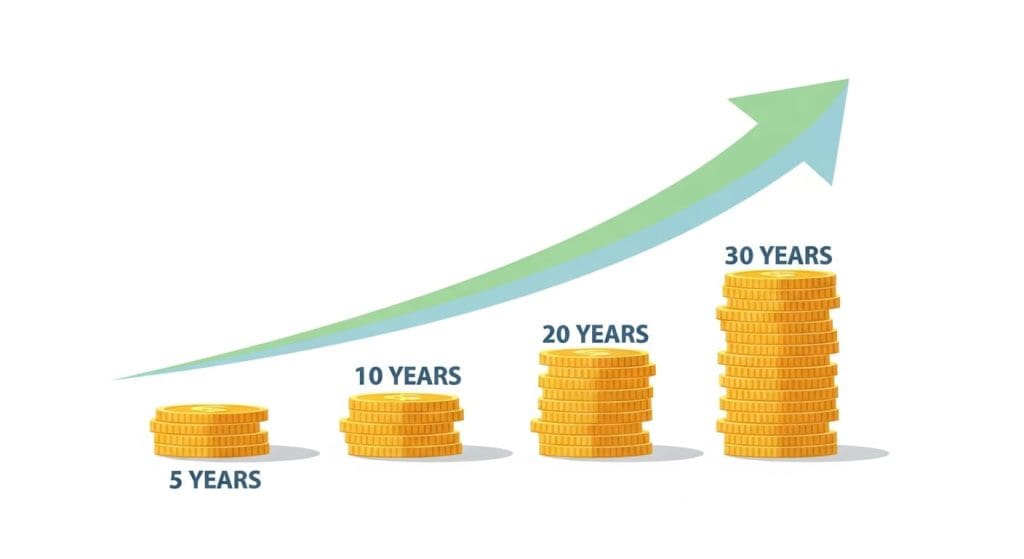
After 20 years: Your contributions total $24,100. Your portfolio would be worth approximately $76,000. More than two-thirds of your total balance comes from compounding, not from money you deposited.
After 30 years: Contributions: $36,100. Portfolio value: approximately $226,000. At this point, your investment returns ($190,000) dwarf your actual contributions by more than five to one.
These numbers are not hypothetical fantasies. They reflect the actual long-term performance of a diversified stock market index fund. The Investment Association in the UK ran similar calculations and found that even £50 per month invested in a typical global equity fund over five years would be worth roughly £3,906 — over £900 more than keeping the same amount in a cash savings account.
The key takeaway is not the specific dollar figure. It is the habit. Starting with $100 and staying consistent is what transforms modest contributions into life-changing wealth.
Common Beginner Mistakes to Avoid When Investing With Little Money
Even with the best intentions, new investors often stumble in predictable ways. Recognizing these mistakes upfront can save you years of frustration and lost returns.
Waiting for the “perfect” time to invest. Market timing — trying to buy at the bottom and sell at the top — is a strategy that fails even for professionals. Research from J.P. Morgan has shown that missing just the 10 best trading days in the S&P 500 over a 20-year period can cut your total returns in half. The best approach is consistent investing through all market conditions, a strategy known as dollar-cost averaging.

Investing before building an emergency fund. Before putting money into the market, make sure you have three to six months of essential expenses saved in a liquid, accessible account. Without this cushion, a car repair or medical bill could force you to sell investments at a loss.
Chasing hot tips and trends. Meme stocks, cryptocurrency hype, and social media influencers promising 10x returns are not investment strategies. They are speculation. There is a place for risk-taking, but it should never involve money you cannot afford to lose. Stick to diversified, low-cost funds for the core of your portfolio.
Ignoring fees. A 1% annual fee might sound small, but over 30 years it can consume over 25% of your total returns. Always check the expense ratio of any fund you invest in. Target funds with expense ratios below 0.20%.
Checking your portfolio too often. The stock market fluctuates daily. Watching it constantly creates anxiety and tempts you to make emotional decisions. Set up automatic contributions, review your portfolio once per quarter, and otherwise leave it alone.
Not diversifying. Putting all your money into a single stock, sector, or country is a recipe for unnecessary risk. A single broad-market index fund gives you exposure to hundreds of companies across dozens of industries.
For strategies on increasing the amount you have available to invest each month, read more
FAQs
Can I really start investing with just $100?
Yes. Many major brokerage platforms — including Fidelity, Schwab, Robinhood, and Trading 212 — have no minimum deposit requirement. Some micro-investing apps like Acorns let you start with as little as $5. The important thing is not the amount you start with but the consistency of your contributions over time.
What is the safest investment for beginners?
Broad-market index funds, such as those tracking the S&P 500 or a total world stock index, are widely considered the safest entry point for long-term investing. They provide instant diversification, have low fees, and have historically delivered positive returns over every 20-year rolling period in modern market history. That said, all investments carry some risk, and past performance does not guarantee future results.
How much should a beginner invest per month?
A common guideline is to invest at least 10–15% of your after-tax income. However, if that feels out of reach right now, even $25 or $50 per month is a meaningful start. The most important factor is building the habit. You can increase your contributions as your income grows or as you reduce expenses.
Is investing better than saving in a bank account?
For long-term goals (five years or more), investing historically outperforms savings accounts by a significant margin. The S&P 500 has averaged roughly 10% annually over the past 30 years, while most savings accounts offer 0.5% to 5%. However, savings accounts are better for short-term needs and emergency funds because they offer guaranteed principal protection and immediate access to your money.
Do I need to pay taxes on investment gains?
Yes, in most countries investment profits are subject to some form of taxation. In the U.S., capital gains tax applies when you sell investments at a profit, though tax-advantaged accounts like Roth IRAs can shelter gains. In the UK, a Stocks and Shares ISA allows up to £20,000 per year in tax-free investing. In the EU, tax rules vary by country, so check your local regulations. Using tax-advantaged accounts is one of the simplest ways to boost your net returns.
Conclusion
You do not need a fortune to start building one. Here are the three key takeaways from this guide. First, time and consistency matter far more than the amount you start with — $100 per month invested over 30 years can grow to over $226,000. Second, low-cost index funds are the most proven, beginner-friendly investment vehicle available, outperforming the majority of professional fund managers year after year. Third, the biggest risk is not market volatility — it is inaction. Every month you delay is compounding growth you will never recover.
Save this guide and revisit it as you grow your portfolio. When you are ready for your next step, read next
