
Student loan debt is a financial weight that tens of millions of people carry for years — sometimes decades. In the United States alone, total student loan debt has reached a staggering $1.83 trillion, spread across roughly 43 million borrowers. Across the Atlantic, the average UK graduate now leaves university owing around £53,000. If you’ve ever searched how to pay off student loans fast, you already know the urgency of wanting that burden off your shoulders.
The good news? Paying off student loans faster than your standard repayment schedule is absolutely achievable — and it doesn’t require a six-figure salary to make it happen. It does require a clear strategy, some discipline, and knowing exactly which tools are available to you.
In this guide, you’ll learn proven student loan repayment strategies that real borrowers use to cut years off their repayment timelines. We’ll cover everything from understanding your loan type, to building a practical payoff plan, to determining whether forgiveness programs or refinancing make sense for your situation. Whether you owe $20,000 or $120,000, the principles here apply.
Let’s get into it.
Table of Contents
- How Much Student Loan Debt Does the Average American Have?
- Understanding Your Loan Type: Federal vs Private
- The 5 Best Student Loan Repayment Strategies
- Income-Driven Repayment Plans Explained
- Should You Refinance Your Student Loans?
- How to Pay an Extra $200/Month Toward Loans
- Student Loan Forgiveness Programs: Do You Qualify?
- Your 12-Month Student Loan Payoff Action Plan
- FAQs
- Conclusion
How Much Student Loan Debt Does the Average American Have?
Before you build a student loan payoff plan, it helps to understand where you stand relative to the broader landscape.
According to the Education Data Initiative (updated 2026), the average federal student loan balance per borrower is $39,547. When private student loans are included, that average rises to approximately $43,333. The total outstanding student loan debt in the U.S. stands at $1.833 trillion, making it the second-largest category of consumer debt after mortgages.

Here’s a breakdown by degree level that puts things in perspective:
- Bachelor’s degree graduates: Average debt of approximately $29,400
- Master’s degree holders: Average debt of approximately $71,000
- Professional degree holders (law, medicine): Average debt exceeding $145,000
- Doctoral degree holders: Average debt of approximately $159,000
The situation isn’t unique to the United States. In the UK, the average student loan debt for graduates who finished their courses in 2024 reached approximately £53,000 — among the highest in the developed world, though the repayment structure differs significantly (UK loans are income-contingent and written off after 40 years under Plan 5).
In parts of the EU, tuition tends to be far lower, but students in countries like the Netherlands, Sweden, and Denmark still take on living-cost loans that can total €15,000–€30,000 by graduation.
No matter where you fall on this spectrum, the fastest way to pay student loans is to start with a clear picture of your balance, interest rate, and repayment term — then apply the strategies below.
Understanding Your Loan Type: Federal vs Private
Not all student loans work the same way, and the strategies available to you depend heavily on whether your loans are federal or private. This distinction is critical before choosing a repayment path.
Federal Student Loans are issued by the U.S. government (through the Department of Education). They come with fixed interest rates, access to income-driven repayment plans, deferment and forbearance options, and eligibility for forgiveness programs like Public Service Loan Forgiveness (PSLF). Federal loan types include Direct Subsidized Loans, Direct Unsubsidized Loans, Direct PLUS Loans, and Direct Consolidation Loans.
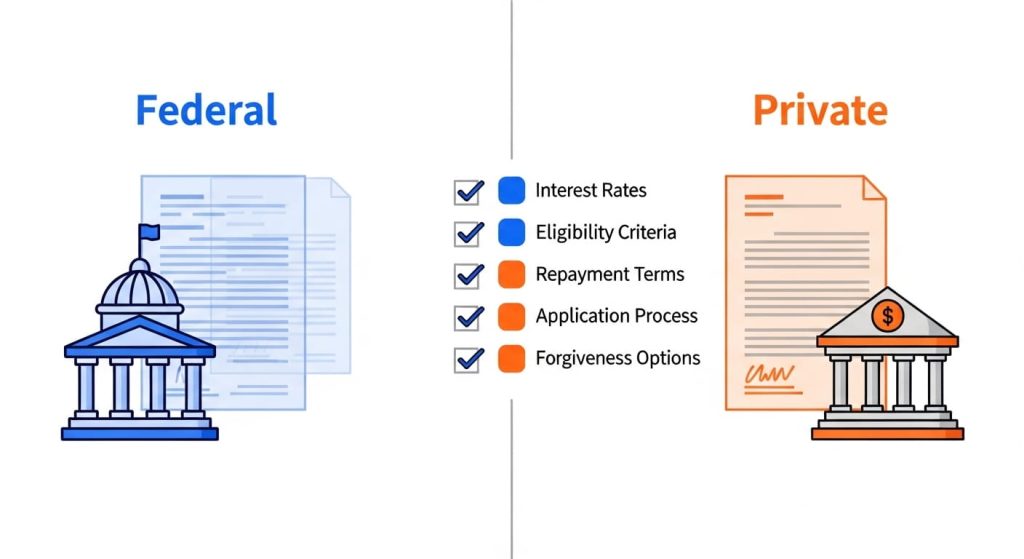
Private Student Loans are issued by banks, credit unions, and online lenders. Interest rates can be fixed or variable and are based on your credit score and financial history. Private loans generally do not offer income-driven repayment, forgiveness programs, or the same flexible hardship options that federal loans provide.
In the UK, student loans are issued by the Student Loans Company (SLC) and function differently — repayment is automatically deducted from your salary once you earn above a threshold (currently £25,000 for Plan 2 borrowers). There’s no equivalent of “private student loans” in the American sense, though some graduates do use personal loans or overdrafts for education costs.
Why this matters for your payoff strategy: If you hold federal loans, you have tools like IDR plans and PSLF at your disposal. If your loans are private, refinancing for a lower rate becomes your primary lever for saving money. Knowing your loan type is always step one.
Log into your loan servicer’s website or check StudentAid.gov (for U.S. borrowers) to confirm exactly what you owe, to whom, and at what interest rate.
The 5 Best Student Loan Repayment Strategies
If you want to know how to pay off student loans fast, these five strategies are the most effective and widely recommended by financial experts.

1. The Debt Avalanche Method
With this approach, you make minimum payments on all your loans and put every extra dollar toward the loan with the highest interest rate first. Once that’s paid off, you roll that payment into the next-highest-rate loan.
Why it works: It minimizes the total interest you pay over time. Mathematically, this is the optimal strategy for saving money.
2. The Debt Snowball Method
Made popular by financial educator Dave Ramsey, the snowball method targets the smallest balance first, regardless of interest rate. Once the smallest loan is gone, you apply that payment to the next smallest.
Why it works: The psychological wins of eliminating individual loans keep you motivated. Research from the Harvard Business Review has found that the snowball method leads to higher completion rates because of its motivational effect.
3. Biweekly Payments
Instead of making one monthly payment, split it in half and pay every two weeks. Because there are 52 weeks in a year, you end up making 26 half-payments — equivalent to 13 full payments instead of 12.
Why it works: You make one extra payment per year without feeling the pinch, which can shave months or even years off your repayment term.
4. Autopay Discount
Most federal loan servicers and many private lenders offer a 0.25% interest rate reduction when you enroll in automatic payments. It may sound small, but on a $40,000 balance, that discount saves you hundreds of dollars over the life of the loan.
5. Lump-Sum Payments
Whenever you receive a tax refund, work bonus, cash gift, or freelance income, apply it directly to your loan principal. A single $1,500 tax refund applied to a $35,000 loan at 5.5% can save you over $800 in interest and cut several months off your payoff date.
The fastest way to pay student loans typically involves combining two or more of these strategies. For example, use the avalanche method as your core approach, enroll in autopay for the rate discount, and commit all windfalls to lump-sum payments.
If you’re looking to free up more cash for these extra payments, our guide on smart budgeting strategies can help you find money you didn’t realize you had.
Income-Driven Repayment Plans Explained
Income-driven repayment (IDR) plans are a federal benefit designed to make monthly payments more manageable by tying them to your income and family size. While IDR plans don’t directly help you pay off student loans fast, they can be a strategic tool — especially if you’re pursuing loan forgiveness.
There are currently several IDR plans available to federal borrowers:
Income-Based Repayment (IBR): Caps payments at 10–15% of your discretionary income (depending on when you first borrowed). Offers forgiveness after 20 or 25 years of qualifying payments.
Pay As You Earn (PAYE): Caps payments at 10% of discretionary income. Forgiveness comes after 20 years. Available only to newer borrowers who took out their first loans after October 2007.
Income-Contingent Repayment (ICR): Caps payments at 20% of discretionary income or what you’d pay on a 12-year fixed plan, whichever is less. Forgiveness after 25 years.
SAVE Plan (Saving on a Valuable Education): This newer plan was designed to offer the most generous terms, with payments as low as 5% of discretionary income for undergraduate loans. However, as of early 2026, the SAVE plan has faced legal challenges and its full implementation remains in flux. Borrowers should check StudentAid.gov for the most current status.
Who should consider IDR plans? If your loan balance is high relative to your income — for example, if you owe $80,000 but earn $45,000 — an IDR plan prevents you from defaulting while you build your income. If you work in public service, pairing an IDR plan with PSLF can result in significant forgiveness after 10 years (120 qualifying payments).
The key downside: IDR plans extend your repayment period, which means you pay more interest over time unless forgiveness kicks in. They’re a tool, not a shortcut. Use them strategically.
Should You Refinance Your Student Loans?
Refinancing replaces one or more of your existing student loans with a brand-new loan from a private lender — ideally at a lower interest rate, a shorter term, or both. It’s one of the most powerful moves you can make if the conditions are right.
Current refinancing landscape: As of early 2026, student loan refinance rates range from approximately 3.99% to over 10% for fixed-rate loans, depending on the lender, your credit score, income, and chosen term. Borrowers with strong credit (720+) and stable income tend to qualify for the best rates.

How much can you actually save? According to Earnest, it’s realistic for borrowers to save between $8,000 and $15,000 over the life of their loan by refinancing — sometimes more. For example, refinancing a $50,000 loan from 6.8% to 4.5% on a 10-year term could save you approximately $6,400 in interest.
When refinancing makes sense:
- You have private student loans with high interest rates
- Your credit score has improved significantly since you first borrowed
- You have a stable income and aren’t relying on federal protections
- You want to shorten your loan term and pay off debt faster
When refinancing does NOT make sense:
- You hold federal loans and are pursuing PSLF or IDR forgiveness
- You may need access to federal hardship options like deferment or forbearance
- Your credit score or income wouldn’t qualify you for a meaningfully lower rate
Refinancing federal loans with a private lender means permanently giving up access to federal benefits. This is a one-way door. Make sure the savings justify it.
For more on building credit to qualify for better rates, check out our credit card tips and guides.
How to Pay an Extra $200/Month Toward Loans
Paying even a modest amount above your minimum payment can dramatically accelerate your loan payoff. On a $35,000 loan at 5.5% interest with a 10-year standard term, adding just $200/month to your payment could help you pay off the loan nearly 4 years early and save you approximately $4,500 in interest.
But where does that extra $200 come from? Here are practical, realistic ways to find it:
Cut subscription creep. The average American spends over $200/month on subscriptions (streaming, apps, gym memberships, meal kits). Audit every recurring charge and cancel what you don’t actively use. Even trimming $50–$75/month here makes a difference.
Earn with a side hustle. Freelancing, tutoring, rideshare driving, selling items online, or doing part-time remote work can easily generate $200–$500/month. The gig economy makes this more accessible than ever.
Redirect raises and bonuses. When you get a raise at work, commit at least half of the increase to your loan payment before lifestyle inflation absorbs it. A 3% raise on a $50,000 salary is roughly $125/month before taxes — money that can go straight to your principal.
Cook more, dine out less. The average American household spends about $3,700/year on food away from home. Cutting restaurant spending by even a third frees up over $100/month.
Use the “pay yourself first” approach. Set up an automatic transfer to your loan servicer on payday — before you have a chance to spend the money elsewhere. Treating your extra loan payment like a fixed bill makes it effortless.
The key insight is this: you don’t need to overhaul your entire lifestyle. Small, consistent changes compound over time. A student loan payoff plan built on $200/month extra payments is realistic for most working adults and can cut years off your timeline.
Want more ideas for boosting your income? Explore our make money guides for actionable strategies.
Student Loan Forgiveness Programs: Do You Qualify?
Forgiveness programs can eliminate part or all of your remaining student loan balance — but they come with strict eligibility requirements. Here are the major programs to know about:
Public Service Loan Forgiveness (PSLF)
PSLF forgives your remaining federal Direct Loan balance after you make 120 qualifying monthly payments (10 years) while working full-time for a qualifying employer. Qualifying employers include government agencies (federal, state, local, tribal), 501©(3) nonprofit organizations, and certain other public service organizations.
You must be on an income-driven repayment plan or the 10-year standard plan (though the standard plan would leave nothing to forgive). PSLF forgiveness is tax-free.

Teacher Loan Forgiveness
If you teach full-time for five consecutive years at a qualifying low-income school, you may be eligible for up to $17,500 in forgiveness on your Direct Subsidized and Unsubsidized Loans. Highly qualified teachers in math, science, or special education receive the highest amounts.
Income-Driven Repayment Forgiveness
After 20 or 25 years of qualifying payments on an IDR plan, your remaining balance is forgiven. However, under current tax law, this forgiven amount may be treated as taxable income (unlike PSLF), which could result in a significant tax bill. A temporary provision exempting forgiven student loan debt from federal income tax was in place through 2025, so check with a tax professional about the current rules.
State-Level and Employer Programs
Many U.S. states offer their own loan repayment assistance programs (LRAPs) for professionals working in fields like healthcare, law, education, and social work. Additionally, a growing number of employers offer student loan repayment benefits — some contributing $100–$300/month toward employees’ loans.
UK and EU Context
In the UK, student loans are effectively “forgiven” (written off) after a set period: 30 years for Plan 2 borrowers and 40 years for Plan 5 borrowers (those who started courses from August 2023). In several EU countries with income-contingent loan systems, similar write-off periods exist.
Before banking on forgiveness, always confirm your eligibility directly through your loan servicer or official government portals. Forgiveness should complement your payoff strategy, not replace active effort.
Your 12-Month Student Loan Payoff Action Plan
Knowing strategies is one thing. Executing them is another. Here’s a month-by-month action plan to help you make meaningful progress on your student loans over the next year.
Months 1–2: Audit and Organize
Log into every loan account you have. Write down each loan’s balance, interest rate, minimum payment, and servicer. Choose your primary strategy (avalanche or snowball). Sign up for autopay to get the 0.25% rate discount.
Months 3–4: Find Extra Money
Conduct a full subscription audit and cancel unnecessary services. Set a specific monthly side-income goal ($200 is a solid target). Create a bare-bones budget for 90 days to maximize extra payments. Apply any tax refunds or bonuses directly to your highest-priority loan.
Months 5–6: Evaluate Refinancing
If you have private loans or high-rate federal loans you’re not planning to use for forgiveness, get refinancing quotes from at least three lenders. Compare rates, terms, and total interest costs. Only refinance if the savings are clear and you won’t need federal protections.
Months 7–8: Check Forgiveness Eligibility
If you work in public service, education, or healthcare, submit a PSLF Employment Certification Form. Research state-specific LRAP programs. Ask your employer about student loan repayment benefits.
Months 9–10: Increase Your Income
Negotiate a raise or seek a higher-paying role. Start or scale a side hustle. Apply 100% of any new income to your loans for these two months as a focused sprint.
Months 11–12: Review and Recalibrate
Compare your current balances to where you started. Calculate how much interest you’ve saved and how many months you’ve cut off your timeline. Adjust your plan for the next 12 months. Celebrate your progress — it matters for sustained motivation.
By following this plan consistently, most borrowers can make a meaningful dent in their debt within a single year. Some may pay off smaller loans entirely. The point isn’t perfection — it’s sustained, strategic effort.
Frequently Asked Questions
What is the fastest way to pay off student loans?
The fastest way to pay off student loans is to combine the debt avalanche method (targeting the highest interest rate first) with extra monthly payments, autopay discounts, and lump-sum payments from windfalls like tax refunds or bonuses. Borrowers who aggressively apply even $200–$300/month extra can shave years off a standard 10-year repayment term.
Can I pay off student loans early without a penalty?
Yes. Federal student loans in the U.S. have no prepayment penalties. You can pay as much extra as you want, whenever you want, with no fees. Most private lenders also do not charge prepayment penalties, though you should confirm this in your loan agreement. In the UK, there’s no penalty for overpaying your student loan either.
Is it better to save money or pay off student loans?
It depends on your interest rate and financial safety net. Most financial advisors recommend building a small emergency fund (1–3 months of expenses) first, then aggressively paying down student loans — especially if your loan interest rate is above 5%. If your rate is very low (under 3-4%), you might benefit from investing the extra money instead, but this involves risk. A balanced approach often works best.
Should I consolidate or refinance my student loans?
Federal consolidation combines multiple federal loans into one, simplifying your payment but not necessarily lowering your rate (it uses a weighted average). Refinancing with a private lender can lower your rate, but you lose federal benefits. Consolidate if you want simplicity with federal protections. Refinance if you have strong credit and want to save on interest — but only if you don’t need forgiveness or IDR plans.
How long does it realistically take to pay off $40,000 in student loans?
On a standard 10-year federal repayment plan at 5.5% interest, $40,000 in student loans would be paid off in exactly 10 years with a monthly payment of approximately $434. By adding $200/month extra, you could pay it off in roughly 6.5 years and save over $5,000 in interest. With aggressive repayment ($800+ extra/month), some borrowers clear $40,000 in 3–4 years.
Conclusion
Paying off student loans faster comes down to three fundamentals: know exactly what you owe, choose a repayment strategy that fits your financial situation, and find consistent ways to pay more than the minimum. Whether you use the avalanche method, refinance for a lower rate, or pursue forgiveness through public service, the most important step is the one you take today.
You don’t need to do everything at once. Start with your 12-month action plan, build momentum, and adjust as your income grows. Every extra dollar you put toward your principal is money you’ll never pay interest on again.
Save this guide and come back to it whenever you need a reset. And when you’re ready for your next financial move, read our guide on smart investing for beginners to start building wealth once your loans are behind you.
