
Introduction
A single number quietly controls some of the most important financial decisions in your life. Whether you’re applying for a mortgage in London, leasing a car in Texas, or opening a credit line in Berlin, your credit score determines the interest rate you pay — or whether you get approved at all.
According to Experian, the average FICO Score in the United States dipped to 713 in 2025, down slightly from the record high of 715. Millions of consumers on both sides of the Atlantic are sitting on scores that cost them thousands in higher interest every year. The good news? Learning how to improve your credit score fast is not as complicated as the financial industry makes it seem.
In this guide, you’ll discover seven research-backed steps that real people use to raise their scores — some in as little as 30 days. No gimmicks, no paid “credit repair” schemes, and no fluff. Just practical, proven strategies that work whether you’re in the USA, the UK, or the EU. Let’s get your score moving in the right direction.
Table of Contents
- What Is a Credit Score and Why Does It Matter?
- What Affects Your Credit Score?
- Step 1: Check Your Credit Report for Errors
- Step 2: Pay Every Bill on Time — Every Single Month
- Step 3: Reduce Your Credit Utilization Below 30%
- Step 4: Don’t Close Your Oldest Credit Accounts
- Step 5: Limit Hard Inquiries on Your Credit File
- Step 6: Become an Authorized User
- Step 7: Diversify Your Credit Mix
- How Long Does It Take to Improve Your Credit Score?
- FAQs About Improving Your Credit Score Fast
- Conclusion
What Is a Credit Score and Why Does It Matter?
A credit score is a three-digit number that represents your creditworthiness — essentially, how likely a lender believes you are to repay borrowed money. In the United States, the most widely used model is the FICO Score, which ranges from 300 to 850. Scores of 670–739 are considered “good,” 740–799 are “very good,” and anything above 800 is “excellent,” according to Equifax.
In the United Kingdom, the landscape is slightly different. Three main credit reference agencies — Experian, Equifax, and TransUnion — each use their own scoring scales. Experian UK scores range from 0 to 1250 (with 861–1000 considered “good”), while Equifax UK scores run from 0 to 1000 (531–670 is “good”). In the European Union, credit scoring varies by country, but the underlying principle is the same: a higher score means better access to credit at lower rates.
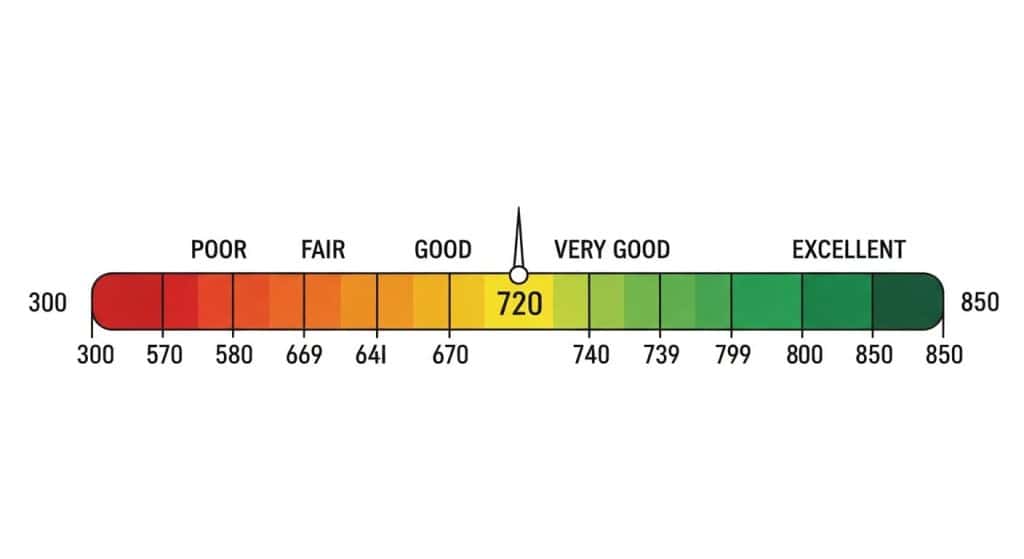
Why does this matter in real terms? A borrower with a FICO Score of 760 or above will typically qualify for the lowest available mortgage interest rate. According to data from myFICO, the difference between a “fair” and “excellent” credit score on a 30-year, $300,000 mortgage can amount to over $100,000 in extra interest payments over the life of the loan. That’s a staggering cost for not managing a number that is largely within your control.
Understanding where you stand is the first step toward knowing how to improve your credit score fast and save yourself real money.
What Affects Your Credit Score?
Before you can raise your score, you need to understand what drives it. The FICO scoring model breaks down into five key factors, each carrying a specific weight.
Payment history is the single most influential factor, accounting for 35% of your FICO Score. Lenders want to see that you consistently pay your bills on time. Even a single missed payment can cause a significant drop.
Amounts owed, also known as credit utilization, makes up 30% of your score. This measures how much of your available revolving credit you’re currently using. If you have a total credit limit of $10,000 and you’re carrying $4,000 in balances, your utilization rate is 40% — higher than the recommended threshold.
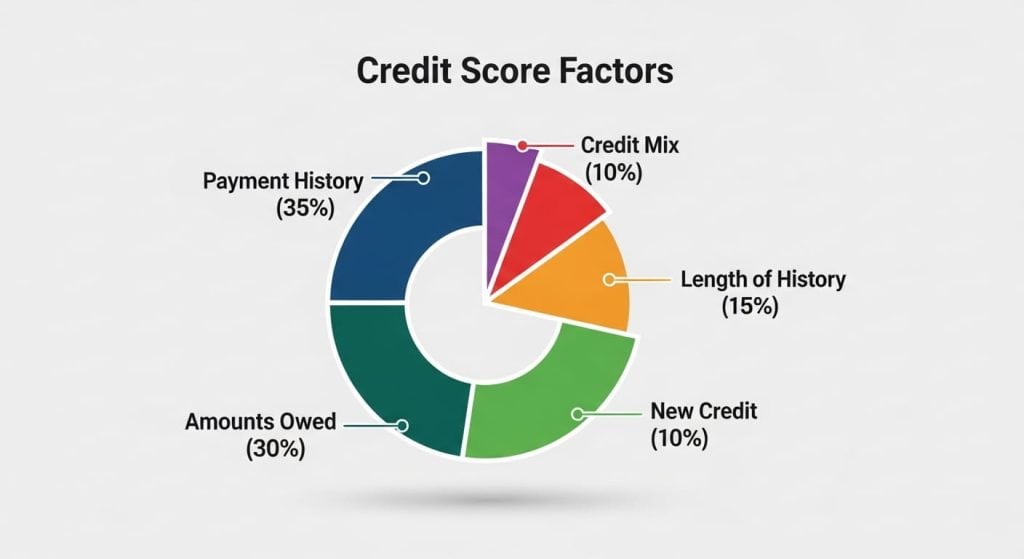
Length of credit history contributes 15%. The longer your accounts have been open and in good standing, the better. This is why financial experts consistently advise against closing older accounts.
New credit accounts for 10% of your score. Every time you apply for a new credit card or loan, the lender performs a “hard inquiry,” which can temporarily lower your score by a few points.
Finally, credit mix makes up the remaining 10%. Having a healthy variety of credit types — such as a credit card, a car loan, and a mortgage — signals to scoring models that you can manage different kinds of debt responsibly.
Understanding these percentages gives you a strategic roadmap. If you want to boost your credit score quickly, focus your energy on the categories with the most weight: payment history and utilization.
Step 1: Check Your Credit Report for Errors
This is the fastest, most overlooked way to improve your credit score — and it costs nothing. Research from the Federal Trade Commission (FTC) found that one in five consumers had an error on at least one of their credit reports. A separate 2024 study by Consumer Reports found that 44% of participants who checked their reports discovered at least one mistake, and 27% found errors serious enough to affect their creditworthiness.
Errors can include accounts that don’t belong to you, incorrect late payment records, wrong account balances, duplicate entries, or outdated negative information that should have been removed. Any of these can drag your score down without you even knowing.

Here’s how to check and dispute errors, depending on your region:
In the United States, you’re entitled to one free credit report per year from each of the three major bureaus (Equifax, Experian, and Trans Union) through AnnualCreditReport.com. In the UK, you can access your report for free through services like ClearScore, Credit Karma, or directly from Experian and Equifax. In many EU countries, credit agencies are required by law under GDPR to provide free access to your data upon request.
Once you spot an error, file a dispute directly with the credit bureau that is reporting the incorrect information. Under the Fair Credit Reporting Act (in the US) and similar consumer protection laws in the UK and EU, bureaus are required to investigate disputes — typically within 30 days. If the error is confirmed, it must be corrected or removed, and your score can improve almost immediately.
If you’re serious about learning how to improve your credit score fast, this single step could yield the biggest initial gain. For more on managing your finances effectively, read our guide on budgeting strategies that actually work.
Step 2: Pay Every Bill on Time — Every Single Month
Since payment history accounts for 35% of your FICO Score, this step is non-negotiable. A single payment that is 30 or more days late can cause your score to drop by as much as 100 points, depending on how high your score was before the missed payment. According to FICO data, the higher your score, the harder the fall — a consumer with a 780 score will lose more points from one late payment than someone already at 620.
The most practical way to guarantee on-time payments is to set up autopay for at least the minimum amount due on every account. Most banks, credit card issuers, and utility providers offer this feature at no cost. If autopay feels risky because of variable income, set calendar reminders for three days before each due date so you have time to review and pay manually.
This strategy applies universally. Whether you hold a credit card from Barclays in the UK, a revolving account from a German bank, or an American Express card in the US, on-time payment is the single most powerful habit for building and maintaining a strong credit score.
If you’re behind on payments, don’t panic. The impact of a late payment diminishes over time. After 12 months of consistent, on-time payments, your score will begin to recover noticeably. After 24 months, the effect is minimal. The key is to start now and never miss again.
Step 3: Reduce Your Credit Utilization Below 30%
Credit utilization — the percentage of your available credit that you’re currently using — is the second-largest factor in your score, responsible for roughly 30% of your FICO Score. The Consumer Financial Protection Bureau (CFPB) recommends keeping your utilization below 30%, but data consistently shows that consumers with the highest credit scores maintain utilization rates below 10%.
Here’s a practical example: if you have two credit cards with a combined limit of $8,000 and your total balance across both is $3,500, your utilization rate is approximately 44%. That’s hurting your score. Paying that balance down to $2,400 would bring you to 30%. Paying it down to $800 would bring you to 10% — the sweet spot.
There are several ways to lower utilization quickly. First, make mid-cycle payments. Don’t wait for your statement to close. Paying down balances before the statement closing date means a lower balance gets reported to the credit bureaus. Second, request a credit limit increase. If your card issuer raises your limit from $4,000 to $6,000, your utilization drops instantly without you paying a cent — just don’t spend the extra available credit. Third, spread your spending across multiple cards rather than maxing out a single one, as per-card utilization also matters in some scoring models.
This is one of the quickest levers you can pull. Because utilization has no memory in most scoring models, the moment a lower balance is reported, your score reflects the improvement. If you want to know how to improve your credit score fast, reducing utilization is the closest thing to an instant fix.
For more tips on reducing debt effectively, check out our article on smart ways to pay off credit card debt.
Step 4: Don’t Close Your Oldest Credit Accounts
It might feel satisfying to close a credit card you no longer use, but doing so can actually hurt your score in two ways. First, it reduces your total available credit, which increases your utilization ratio. Second, it can shorten your average account age over time, which negatively affects the “length of credit history” factor (15% of your FICO Score).
Consider this scenario: you have three credit cards with a combined limit of $15,000. You close the oldest card, which had a $5,000 limit and has been open for 12 years. Your total available credit drops to $10,000, and your average account age decreases significantly. Both changes push your score downward.
Instead of closing old accounts, keep them open and use them occasionally for a small recurring charge — like a streaming subscription — to prevent the issuer from closing the account due to inactivity. Pay the balance in full each month, and you’ll maintain both the credit limit and the account history without paying any interest.
This advice is particularly relevant for UK consumers, where credit reference agencies like Experian also factor in the age of your credit accounts. In the EU, while scoring models vary, the principle of demonstrating a long, stable credit relationship holds true across most markets.
The bottom line: unless a card carries an annual fee you can’t justify, keeping old accounts open is one of the simplest things you can do to protect — and gradually increase — your score.
Step 5: Limit Hard Inquiries on Your Credit File
Every time you apply for a new credit card, personal loan, car financing, or mortgage, the lender performs a hard inquiry (also called a “hard pull”) on your credit file. Each hard inquiry can reduce your score by 2 to 5 points, and the inquiry remains on your report for up to two years, though its scoring impact typically fades after 12 months.
The real danger isn’t a single inquiry — it’s multiple inquiries in a short period. To a scoring model, a flurry of credit applications can signal financial distress, even if you’re simply shopping around for the best rate.
There is an important exception: rate shopping. FICO and VantageScore models recognize that consumers shopping for a mortgage, auto loan, or student loan may generate multiple inquiries within a short window. These are typically grouped together and counted as a single inquiry if they occur within a 14- to 45-day window (depending on the scoring model version). So when you’re comparing mortgage rates, do your shopping within a concentrated timeframe.
To protect your score day-to-day, avoid applying for retail store cards on impulse — especially those “Save 20% today!” offers at checkout. The small discount is rarely worth the hard inquiry and the temptation of a new credit line. Instead, be strategic about when and why you apply for new credit.
Step 6: Become an Authorized User
If you’re building credit from scratch or recovering from past mistakes, becoming an authorized user on a trusted family member’s or partner’s credit card account can give your score a meaningful boost. Research from Rice University and the University of Wisconsin, analyzing 16 years of credit data, found that authorized users received an average credit score boost of roughly 30 points compared to peers their age with no credit history.
Here’s how it works: when you’re added as an authorized user, the account’s payment history, age, and credit limit may be reported on your credit file as well. If the primary cardholder has a long-standing account with on-time payments and low utilization, those positive characteristics can benefit your score.
However, this strategy carries risk in both directions. If the primary account holder misses payments or carries high balances, those negatives will appear on your report too. It’s essential to choose an account holder who manages credit responsibly. You also don’t need to physically use the card — simply being listed on the account is enough in many cases.
This approach is recognized by both FICO and VantageScore models in the US. In the UK, the equivalent concept is a “financial association” — being linked on a joint account or as a secondary cardholder can influence your credit profile. Choose these associations carefully, because they can work against you as easily as they work for you.
Step 7: Diversify Your Credit Mix
The final 10% of your FICO Score comes from your credit mix — the variety of credit accounts you hold. Scoring models reward consumers who demonstrate the ability to manage different types of credit responsibly, including revolving credit (credit cards), installment loans (auto loans, personal loans, mortgages), and retail accounts.
This doesn’t mean you should take out a loan you don’t need just to check a box. However, if you only have credit cards, adding an installment loan — such as a small credit-builder loan from a credit union — can diversify your profile. Many credit unions and fintech companies now offer credit-builder loans specifically designed for this purpose, often with loan amounts as low as $300–$1,000.
In the UK, products like Loqbox and credit-builder cards from companies such as Vanquis serve a similar function, helping consumers build a broader credit profile without taking on significant debt.
The key principle is this: don’t chase credit mix aggressively, but don’t ignore it either. If you’re already doing everything else right and your score is plateauing, adding a different type of credit account could provide that extra nudge upward.
For a broader view on building long-term financial health, explore our guide on investing basics for beginners.
How Long Does It Take to Improve Your Credit Score?
One of the most common questions is: “How fast can I actually see results?” The honest answer is that it depends on what’s pulling your score down.
Credit utilization changes can show results the fastest. Because utilization is recalculated each time your card issuer reports your balance to the bureaus (usually once per month), paying down a high balance can improve your score within 30 to 45 days.
Correcting a credit report error can also produce a relatively quick improvement. Once a dispute is resolved and the error is removed — typically within 30 days — your score is recalculated with the corrected data.
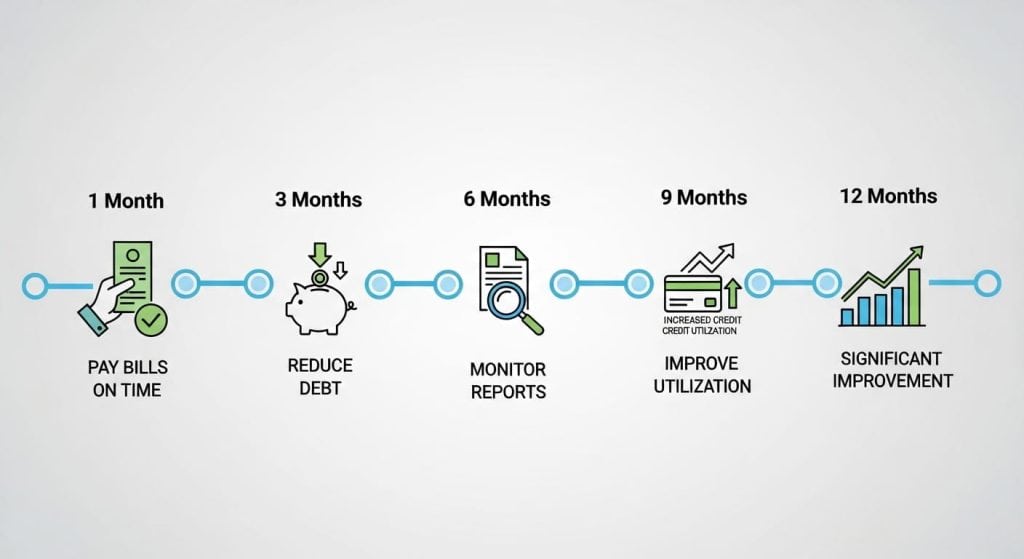
A single missed payment takes longer to overcome. According to data compiled by Take Charge America, a late mortgage payment (30–90 days) can take approximately 9 months to recover from. A single missed payment on a credit card may take 12–18 months to fully heal, assuming all subsequent payments are made on time.
Serious negative marks — such as bankruptcies, foreclosures, or accounts sent to collections — remain on your credit report for 7 to 10 years in the US and 6 years in the UK. Their impact diminishes over time, but full recovery is a longer journey.
The most realistic timeline for most people? If your score is in the “fair” range (580–669 in the US) and you follow all seven steps outlined above consistently, you can reasonably expect to see a 50- to 100-point improvement within 6 to 12 months. The largest gains tend to come early on, especially from fixing errors and lowering utilization.
Patience matters, but so does urgency. Start today, and your future self will thank you.
FAQs About Improving Your Credit Score Fast
Does checking my own credit score hurt it?
No. Checking your own credit score or pulling your own credit report is considered a “soft inquiry” and has absolutely no impact on your score. You can check as often as you like through free services like Credit Karma, ClearScore (UK), or directly through your bank. In fact, monitoring your score regularly is one of the best habits you can develop.
Can I improve my credit score by 100 points in 30 days?
It’s possible in specific circumstances, but it’s not typical. If your score is being dragged down by a major error on your credit report (such as a falsely reported missed payment or an account that doesn’t belong to you), getting that error removed could result in a dramatic improvement within a single billing cycle. Similarly, paying down very high utilization to below 10% can produce a significant jump. For most people, though, a 100-point increase is more realistic over 3 to 6 months of disciplined action.
What is the fastest way to build credit if I have no credit history?
If you’re starting from zero, there are several effective strategies. A secured credit card — where you put down a deposit that serves as your credit limit — is one of the most accessible options. Credit-builder loans from credit unions are another strong choice. In the UK, credit-builder cards from providers like Aqua or Vanquis are designed specifically for this purpose. You can also ask a family member to add you as an authorized user on their account to begin building a credit file quickly.
Does paying off a collection account improve my credit score?
It depends on the scoring model. Under FICO Score 9 and VantageScore 3.0 and 4.0, paid collections are excluded from the score calculation, meaning paying them off can help. However, under older FICO models (like FICO Score 8, which many lenders still use), a collection account continues to impact your score whether paid or unpaid — although a paid collection looks better to a human loan officer reviewing your file. Always negotiate a “pay for delete” agreement if possible, where the collection agency agrees to remove the account entirely once paid.
How often should I check my credit report?
You should review your full credit report at least once every four months — ideally rotating between the three major bureaus so you’re checking one report every quarter. This allows you to catch errors, spot unauthorized accounts early, and track your progress over time. In the US, AnnualCreditReport.com provides free weekly access to your reports. In the UK, services like ClearScore, Credit Karma, and Experian offer ongoing free monitoring.
Conclusion
Improving your credit score is not about tricks or shortcuts — it’s about consistent, smart financial habits that compound over time. The three most important takeaways from this guide are: first, check your credit reports for errors and dispute any inaccuracies immediately — it’s the fastest win available. Second, never miss a payment, because payment history is the single biggest factor in your score. Third, keep your credit utilization below 30% (ideally below 10%) by paying down balances and requesting credit limit increases.
Every step you take today moves you closer to lower interest rates, better loan terms, and greater financial freedom.
Save this guide and revisit it monthly to track your progress. Ready for the next step? Read more .
